The Square Lake Curly-leaf Pondweed Vegetation Management Plan
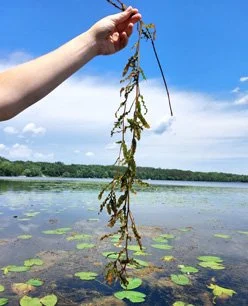
Curly leaf pondweed found in Square Lake
Square Lake is one of the most pristine lakes in the Twin Cities metro, home to clear waters and a diverse plant community that supports vibrant fish and wildlife habitat and delight for swimmers, boaters, anglers, and visitors from all around the region. In 2013, the first and only aquatic invasive species, curly-leaf pondweed (CLP), was discovered in Square Lake. Aquatic invasive species like CLP can threaten lake ecology, recreational use, and even property values. Initially, the Square Lake Association (SLA) sought to eradicate CLP. Over the years, it became clear that CLP was established in the lake – and the plant is nearly impossible to eradicate.
However, CLP can be controlled and risk of spread minimized so that the outstanding ecological and recreational value of the lake is maintained in the future. In 2025, the SLA Board embarked on a collaboration effort with Carnelian-Marine-St. Croix Watershed District, Washington Conservation District, Washington County, and MN DNR to develop a 5-year plan for controlling CLP, maintaining lake health, and establishing best management practices. In January 2026, the SLA finalized the Square Lake Curly-Leaf Pondweed Vegetation Management Plan (LVMP) - SL LVMP – 1-14-26.
The LVMP objectives include:
Small patch of curly leaf pondweed growing among healthy native plants at Square Lake.
Controlling (not eradicating) CLP to limit significant spread in the lake and ensure management actions can maintain high ecological health of the lake’s plant community.
Ensuring that if spread were to occur, we have clear guidance on the best management approach to treat the areas of spread.
Ensuring that management intervention is not having a long term and lasting negative impact on the native plant community.
The LVMP assessed all available management options for the SLA according to effectiveness, cost/labor, and risk of harming existing native plants. Options included herbicide, mechanical removal using specialized machinery, hand pulling/cutting, and a “do-nothing” approach. The best options were compiled into a “decision matrix” to help make annual management decisions based on specific areas of the lake and vegetation monitoring. Selected options include:
Hand removal of CLP. Hand removal is labor intensive and requires long-term persistence to keep CLP in check. However, the CLP at Square Lake is an ideal opportunity for hand removal due to its passionate volunteer base, relatively small patches of CLP, and CLP patches at shallow depths which makes hand pulling easier.
Do-nothing. A do-nothing approach may be appropriate at Square Lake, since the excellent water quality and native plants provide natural resilience to CLP. Yet the do-nothing approach presents risk and uncertainty over spread, especially if water quality were to negatively change in the future.
Herbicide control. Herbicide control is accepted statewide as a reliable and cost-effective tool to keep CLP in check and has been used at Square Lake several times over the past decade. But results from herbicide control at Square Lake over the years are inconclusive, and prolonged use risks harm to the native vegetation and could favor CLP long-term. Therefore, herbicide use is only advocated for Square Lake if existing CLP increases in area or abundance and provided no negative impacts to native plants are documented.
A critical element of the LVMP is monitoring. Annual surveys of lake vegetation will inform appropriate LVMP management practices, and document success of CLP control efforts and health of native plants. Through monitoring, actions will be based on real-world conditions and provide a platform for achieving LVMP goals within the 5-year management period and beyond.
What’s Next?
The three different CLP management zones at Square Lake. Zone A (red) is the historically the densest area of CLP, with some plants occasionally found in Zone B (yellow). The vast majority of the lake in Zone C (green) has no CLP.
Year 1 of the LVMP is kicking off in spring 2026! Monitoring data from 2025 recommended hand-removal as the best control option, and the SLA is gearing up a group of dedicated volunteers. A preliminary survey will be completed by EOR, Inc. in April 2026, followed by volunteer efforts to remove mapped CLP in May. Volunteers will walk, wade, and paddle the shoreline, pulling CLP and disposing of the plants outside of the lake. A follow up survey in June will document removal effectiveness, and ongoing monitoring of the lake for remaining CLP to be managed in 2027. The volunteer effort represents SLA’s tremendous commitment to keeping Square Lake pristine and relies on the momentum of existing and new volunteers. Thank you to all who are committing your time to this project!
The overall cost of 2026 LVMP implementation is expected to be $11,100, supplemented by a $4,000 Washington County AIS Control Grant and a proposed $5,050 cost share from Carnelian-Marine-St. Croix Watershed District. These grant funds are available thanks to our dedicated partners and the accomplishment of the 2025 LVMP. Future years are expected to save funds by further developing the volunteer program.
How Can You Help?
We are currently recruiting volunteers for the following LVMP committees:
Lake Steward – Lynn Mecum, Team Lead.
Manual CLP Extraction – Alicia Blanchard and Ann Brookman, Team Co-Leads.
AIS Boat Launch Volunteer Inspection Program – Team Leaders needed.
Please contact the listed Team Leaders to learn more.
If you are unable to volunteer, your financial support will also be greatly appreciated: Square Lake Conservation Fund.
Either way, thanks for your ongoing commitment to Protect & Preserve Square Lake’s uniquely beautiful waters, woodlands, watersheds, and wildlife!
Jimmy Marty, CMWP
EOR: water | ecology | community
jmarty@eorinc.com
Jim Seidl
President, Square Lake Association.
Co-Director, Square Lake Conservancy (Square Lake Conservancy Case Study – October 6, 2023)
jim.seidl@legalresearch.com
“Congratulations on completing your LVMP. I think every lake group should have a plan like this to guide their management, for long-term lake preservation and planning.”
“SLA is a model of how lake associations should operate.”